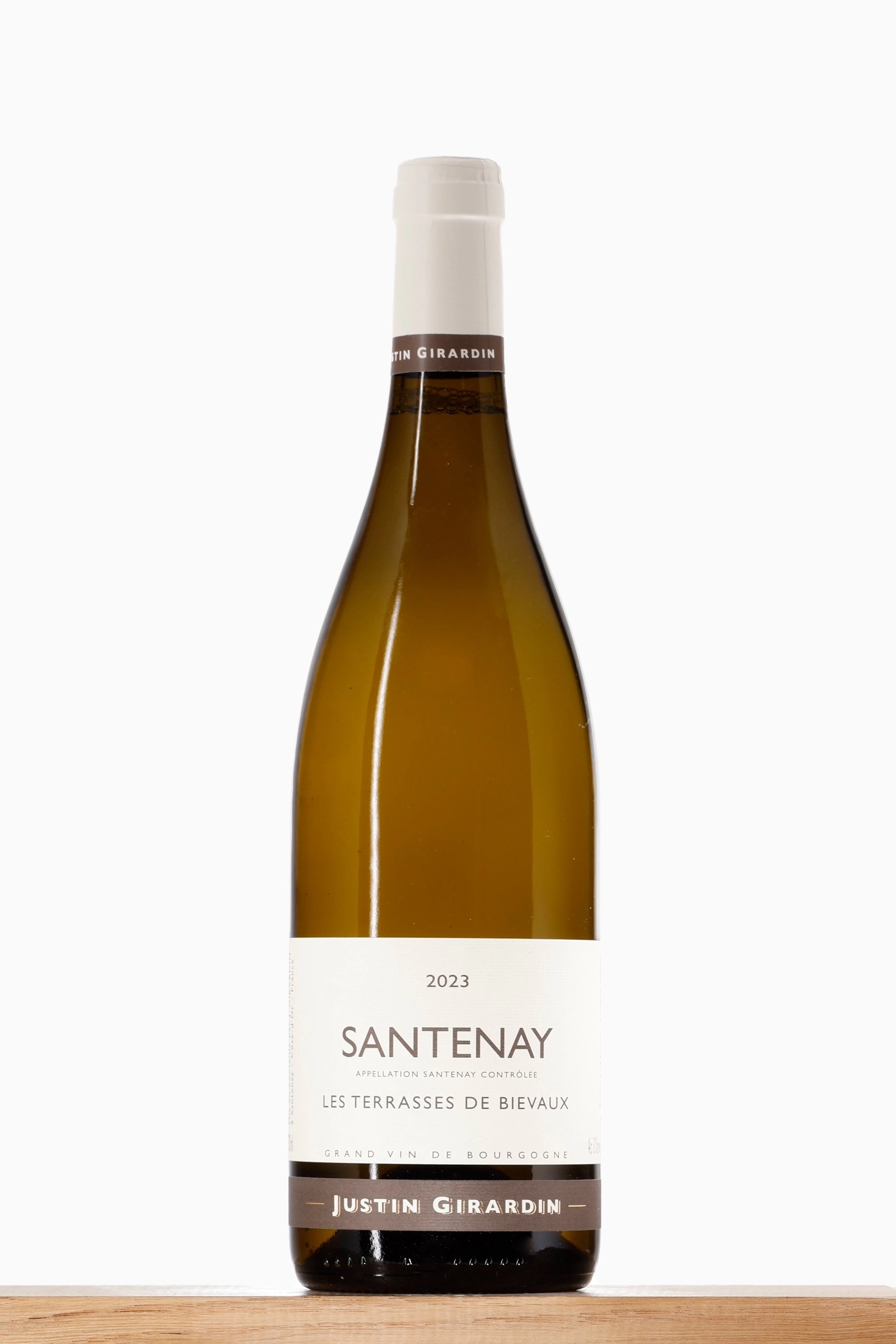
Santenay blanc Les Terrasses de Bievaux 2023 Domaine Justin Girardin
€35.00


-
 Master Cellar Expert Selection
Bottles chosen with passion, directly from the winemakers
Master Cellar Expert Selection
Bottles chosen with passion, directly from the winemakers
-
 Zero Breakage Guarantee
Every order carefully packed, each bottle individually protected
Zero Breakage Guarantee
Every order carefully packed, each bottle individually protected
-
 Tax-Free / Worldwide Shipping
VAT automatically deducted at checkout for non-EU customers, Global Blue in-shop
Tax-Free / Worldwide Shipping
VAT automatically deducted at checkout for non-EU customers, Global Blue in-shop
Product Details
- Format
- 75 cl
- Region
- Bourgogne
- Vintage
- 2023
- Classification
- VILLAGE
- Appellation
- SANTENAY
- Alcohol
- 13°
- Colour
- White
- Country
- FRANCE
- Vineyard site
- LES TERRASSES DE BIEVAUX
- Taster
- Adrien
One of Burgundy's rare terraced vineyard parcels, a singular terroir for white wine. Domaine Justin Girardin's Santenay Blanc reveals floral delicacy, mineral precision, and the vibrant tension that comes from a maigre, calcaire-rich soil worked in biodynamics.
The Santenay Blanc Les Terrasses de Bievaux 2023 from Domaine Justin Girardin is one of the most singular and compelling cuvées of the Côte de Beaune, a Chardonnay born from a steeply terraced terroir, remarkably rare in Burgundy, whose family story runs as deep as its thin, hungry soil. Floral, mineral, and vigorous, it embodies the vision of a thirteenth-generation vigneron, present in Burgundy since 1570, who tends his domaine in biodynamics with a simple and profound philosophy: let nature express itself fully in every glass.
The terroir of Les Terrasses de Bievaux
Les Terrasses de Bievaux rise on the steepest, highest slopes of Santenay. The place name tells its own story: Bievaux derives from the Latin Bedus, meaning water channel, combined with the Burgundian patois vaus, meaning "hilly", referencing the neighbouring spring that once cooled the site naturally. After phylloxera devastated the region in the early twentieth century, all vines on this slope were uprooted and the parcel lay abandoned for decades, despite its historical reputation for excellent white wines. Only in 1986 did Justin's maternal grandfather begin replanting these steep slopes, dividing them into six small parcels and constructing terraces, a monumental and remarkably rare undertaking in Burgundy, to facilitate work and manual harvest. High-altitude and sharply inclined, with a south-west exposure amplified by the terrace structure that captures more sun, this terroir offers perfect conditions for Chardonnay: the soil is maigre, covered in calcaire marls, thin and stony, while the surrounding woods create a cool microclimate that gives the wine its natural freshness and remarkable tension. The vines, around 35 years old, are tended in biodynamics.
Tasting profile
The colour is a bright, pale yellow, limpid and luminous. The nose is floral and delicate, of great finesse: notes of fern and white flowers, acacia and honeysuckle, intertwine with fresh yellow fruit, candied citrus and hazelnut, alongside a chalky, fresh minerality that marks the marl terroir. On the palate, the wine shows vigour, tension and fine precision: the acidity is lively and incisive, bringing natural freshness that structures a texture at once light and generous. The mouthfeel is creamy and silky, shaped by twelve months of ageing in oak with only 15% new wood, subtle and fully integrated. The finish is long, mineral and distinguished, unfolding with elegance over notes of wet chalk and fresh citrus. A Chardonnay both accessible in its vivacity today and promising lovely evolution over four to six years.
The domaine
The Girardin family has been established in Burgundy since 1570. Justin Girardin, the thirteenth generation, took the reins of his family's 17-hectare domaine in 2012 from his father Jacques, brother of the celebrated négociant Vincent Girardin. Watchful of his vines' wellbeing, Justin tends the entire vineyard in biodynamics, without official certification but with complete rigour and conviction. His philosophy is eloquently simple: let nature express itself as fully as possible in the vineyard and in the wine, intervening with restraint and respecting natural rhythms. Clonal biodiversity, manual harvest with triple sorting at the vines and on the vibrating table, fermentation in indigenous yeasts at low temperature, and precise, measured oak ageing are the tools of a vineyard tended like a living garden. His domaine stretches from Santenay through Savigny-lès-Beaune, Chassagne-Montrachet, Pommard and Meursault, each terroir revealed with the same attention and passion.
Food pairings
This Santenay Blanc Les Terrasses de Bievaux pairs beautifully with scallops in beurre blanc with lemon, grilled sole with fresh herbs, chilled langoustines with house-made mayonnaise, steamed prawns, sea bass fillet in herb crust or chicken liver terrine with pistachios. It will also find harmony with soft cheeses such as Chaource, Brie de Meaux or semi-dry goat cheese. Served between 10 and 12°C, it will reveal all the floral freshness and calcaire minerality of a Côte de Beaune Chardonnay of genuine sincerity.
The terroir of Les Terrasses de Bievaux
Les Terrasses de Bievaux rise on the steepest, highest slopes of Santenay. The place name tells its own story: Bievaux derives from the Latin Bedus, meaning water channel, combined with the Burgundian patois vaus, meaning "hilly", referencing the neighbouring spring that once cooled the site naturally. After phylloxera devastated the region in the early twentieth century, all vines on this slope were uprooted and the parcel lay abandoned for decades, despite its historical reputation for excellent white wines. Only in 1986 did Justin's maternal grandfather begin replanting these steep slopes, dividing them into six small parcels and constructing terraces, a monumental and remarkably rare undertaking in Burgundy, to facilitate work and manual harvest. High-altitude and sharply inclined, with a south-west exposure amplified by the terrace structure that captures more sun, this terroir offers perfect conditions for Chardonnay: the soil is maigre, covered in calcaire marls, thin and stony, while the surrounding woods create a cool microclimate that gives the wine its natural freshness and remarkable tension. The vines, around 35 years old, are tended in biodynamics.
Tasting profile
The colour is a bright, pale yellow, limpid and luminous. The nose is floral and delicate, of great finesse: notes of fern and white flowers, acacia and honeysuckle, intertwine with fresh yellow fruit, candied citrus and hazelnut, alongside a chalky, fresh minerality that marks the marl terroir. On the palate, the wine shows vigour, tension and fine precision: the acidity is lively and incisive, bringing natural freshness that structures a texture at once light and generous. The mouthfeel is creamy and silky, shaped by twelve months of ageing in oak with only 15% new wood, subtle and fully integrated. The finish is long, mineral and distinguished, unfolding with elegance over notes of wet chalk and fresh citrus. A Chardonnay both accessible in its vivacity today and promising lovely evolution over four to six years.
The domaine
The Girardin family has been established in Burgundy since 1570. Justin Girardin, the thirteenth generation, took the reins of his family's 17-hectare domaine in 2012 from his father Jacques, brother of the celebrated négociant Vincent Girardin. Watchful of his vines' wellbeing, Justin tends the entire vineyard in biodynamics, without official certification but with complete rigour and conviction. His philosophy is eloquently simple: let nature express itself as fully as possible in the vineyard and in the wine, intervening with restraint and respecting natural rhythms. Clonal biodiversity, manual harvest with triple sorting at the vines and on the vibrating table, fermentation in indigenous yeasts at low temperature, and precise, measured oak ageing are the tools of a vineyard tended like a living garden. His domaine stretches from Santenay through Savigny-lès-Beaune, Chassagne-Montrachet, Pommard and Meursault, each terroir revealed with the same attention and passion.
Food pairings
This Santenay Blanc Les Terrasses de Bievaux pairs beautifully with scallops in beurre blanc with lemon, grilled sole with fresh herbs, chilled langoustines with house-made mayonnaise, steamed prawns, sea bass fillet in herb crust or chicken liver terrine with pistachios. It will also find harmony with soft cheeses such as Chaource, Brie de Meaux or semi-dry goat cheese. Served between 10 and 12°C, it will reveal all the floral freshness and calcaire minerality of a Côte de Beaune Chardonnay of genuine sincerity.